Saltcorner
By Bob Goemans
By Bob Goemans

Not Reef Tank Suitable
Not Suitable for Fish-Only Tank
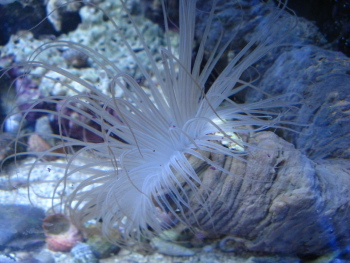
Anemones, are in the Phylum Cnidaria, Class Anthozoa, Subclass Hexacorallia and Order Actiniaria and are basically simple, primitive animals. They range in size from .5 inch to over 4 feet in diameter. Their tube shaped body is usually topped with a ring of tentacles, which selectively feed on planktonic organisms or small fishes. An ring of tentacles surrounds an area known as the oral disc, which contains an opening in the center commonly called the mouth. Food is taken into this opening and waste matter or undigested food is expelled through the same opening. The body column, sometimes referred to as a pedal column, serves as a means for locomotion or as a holdfast.
Should environmental conditions not be suitable, anemones can easily move to where light, water movement and feeding conditions are more favorable. Usually, a moving anemone is a sign it's unhappy with its environment!
Anemones may reproduce sexually or asexually by splitting or fragmentation. With some anemones, asexual reproduction results in the production of clones. Clones of the same specimen can intermingle without any harm to each other. Yet clones of a different individual, even though the same species will do battle with each other. They have been known to live in captivity for almost eighty years.
All anemones are considered carnivorous even though some utilize intense light to trigger symbiotic algae living in their flesh, which in turn produce a portion of their nutritional requirements. Using small nematocysts or stinging cells, which cover the tentacles and which are capable of firing a tiny dart connected with a thin filament into its prey, the anemone is very capable of capturing planktonic organisms and small fishes. Anemones have few enemies, with other anemones, nudibranchs, sea stars and some fishes considered their main predators.
They also have specialized defensive mechanisms that can deter potential predators, e.g., specialized nematocyst at the base of the tentacle; inflating defense tentacles called 'acrorhagi' located just below the oral disc; reducing body size; and, exuding quantities of nematocyst-laden mucous called 'acontia.'
Even though most anemones are considered carnivorous, some that interest aquarists require bright light to trigger their symbiotic algae. If conditions are not suitable, they will move to where conditions will suit them. Therefore, in a mixed anemone and coral environment it's recommended the anemone be placed in the aquarium prior to adding corals so as to allow it to find its own favorite spot. That way, a moving anemone will not harm stationary corals when seeking a new home.
I'll divide this subject matter into three groups, those more properly called 'Sea Anemones' containing many of the preferred species for aquariums, those that are troublesome in aquaria, which I'll call 'Pest Anemones' and finally those that are called 'Tube Anemones' that live inside a tube that they create in muddy or sandy substrate.
Furthermore, where certain corals and anemones are concerned, light intensity and the strength of water movement is paramount to their well-being. Therefore, here and in other areas of this Species Library the following will be shown so as to illuminate those needs in a more hopefully useable and easily understood fashion.
As to PAR impact, there are shallow water/fringing reef stony corals/anemones that require certain levels light to remain healthy/colorful, such as a PAR value of about 400 - 800. Then there are soft and stony corals/other animals liking medium light, such as a PAR value in the range of 100 - 400. As for the low light corals, such as mushrooms and others, they prefer a PAR value of about 50 - 100. For water motion, I've decided to relate it to the visible intensity of water motion on that of a long tentacle anemone. No visible tentacle motion is '0,' whereas a slight movement of some tentacles is '1.' If all the tentacles are gently swaying in the current it is '2.' If all tentacles are moving fairly fast and bouncing into each other it is '3.' Should all tentacles be driven with such force they are extended in one direction or unable to sway back to their central position it's '4.' Try to keep these values in mind, but if necessary revert back to this paragraph, as you will see them as - PAR - XXX & WM - X. Hopefully you'll find this quite helpful.

© 2012 Bob Goemans. All rights reserved.
The material on this site may not be reproduced, distributed, transmitted, cached or otherwise used, except with the prior written permission of Bob Goemans.
